Prediction markets are the hottest thing right now in US sports betting, but to (older) European eyes they look a lot like the betting exchange of the early 2000s.
The best way to predict the future is to create it, opined the management consultant Peter Drucker. Such a statement might be suitable for the fields of innovation and entrepreneurship, but it takes on an altogether different meaning when applied to the hottest sector of the moment in the United States – prediction markets.
In early January 2026 it was reported that a customer of Polymarket made more than $425,000 on a series of positions relating to Venezuela.
The customer seemingly only joined the platform in December 2025 and the capture of Venezuelan president Nicolás Maduro on 3 January secured them a good profit on their $32,000 ‘predictions’.
There were suggestions that the user may have not so much predicted the future as been involved with, or adjacent to, its creation. Dennis Kelleher, chief executive at Better Markets, told CBS that, “this particular bet has all the hallmarks of a trade based on inside information.”
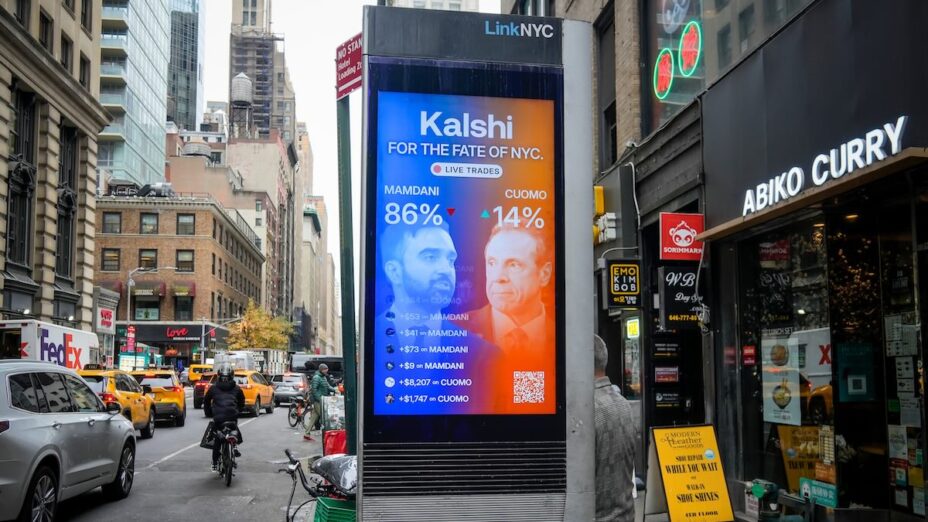
Prediction platforms like Polymarket and Kalshi are the latest development in the evolving US betting sector, with Kalshi valued at $11 billion after a recent funding round in December 2025.
Sports betting brands have also got in on the action. DraftKings Predictions and FanDuel Predicts, for example, are both powered by CME Group.
Underdog Sports, which has been focused on Daily Fantasy Sports (DFS), withdrew its sports betting licence application in Missouri before launch to focus on prediction markets in partnership with Crypto.com.
“Prediction markets are one of the most exciting developments we’ve seen in a long time,” said Underdog founder and CEO Jeremy Levine. “While still new and evolving, one thing is clear – the future of prediction markets is going to be about sports – and no one does sports better than Underdog.”
Prediction markets might well be an exciting development in the US but to UK observers it does look like they are treading along a similar path that betting exchanges forged 25 years ago.
Betfair was launched in the UK in 2000 and its founders both had financial backgrounds in the City of London. Their launch gimmick was to stage a ‘funeral’ for the death of traditional sports betting.
Betting exchanges promised to cut out the middleman and let gamblers bet directly with each other.
But 25 years later, traditional sportsbooks have not been killed off by betting exchanges. Betfair even launched its own fixed-odds sportsbook in 2012 and is now just one of many brands owned by Flutter Entertainment.
Why did betting exchanges not come to dominate in the UK and will similar weaknesses afflict prediction markets in the US?
Winners welcome
A crucial part of the betting exchanges’ offering and appeal was that “winners were welcome”.
Unlike traditional sportsbooks, a betting exchange operator has no vested interest in the result of an event because it simply takes a commission from winning trades. Customers who won consistently would not be restricted in their stakes or have their accounts closed, as might be the case with a sportsbook.
But, while the betting exchanges might welcome winners, the business model still relies on losing accounts.
For both betting exchanges and prediction platforms there have to be two sides to every trade.
Gaining an edge
In the UK, horseracing was a key focus for Betfair and in-running betting in particular. With money to be made, professional traders would go to great lengths to get an edge over less sophisticated gamblers.
These traders would take hospitality boxes at the racecourse to bet live from the track with high-speed internet connections. By being live at the course, they gained an advantage over off-course traders who had to contend with a several second delay to the pictures shown on the racing channels.
When knowledge means profit, there will always be traders seeking an advantage over others, be it on sports, politics or current affairs.
In response to January’s Venezuela predictions, New York Democratic congressman Ritchie Torres introduced legislation seeking to ban government officials and staff from trading on prediction markets concerning government actions or political outcomes when they have “material non-public information”.
Keeping it liquid
Liquidity is crucial to the success of trading platforms. The suggestion with Betfair was that professional traders were extracting liquidity faster than it could be replaced by new money from casual accounts. This scenario restricts how much an exchange can grow and how much it can earn in revenue.
Betfair introduced a premium commission charge in 2008 to slow the rate of extraction and to earn more revenue from accounts which were consistently profitable. The initial rate was 20 per cent but by 2011 there were 40 per cent and 60 per cent rates in force for a small number of accounts.
Winners were still welcome, but they would have to pay for the privilege of being successful.
Betfair replaced its premium charge in 2025 with an “Expert Fee”, which applies at a rate of 20 per cent to accounts with gross profit of more than £25,000 in a rolling 52-week period. A rate of 40 per cent applies to gross profit of more than £100,000.
US prediction platforms operate a slightly different fee model to the betting exchanges, often based on the ‘maker-taker’ model. DraftKings Predictions has a fixed commission per contract plus a third-party exchange fee. Polymarket currently charges no fees for most of the markets it offers.
Regardless of fee model, the platforms have to replace losing customers who leave with new ones. The sharks will be waiting to take the unsophisticated money of the new fish.
The right balance between sharks and fish has to be maintained for the vibrancy of the platform.
In the UK, the betting exchange sector was only really a duopoly, even at its height. The US predictions sector is already more competitive for a much larger population. It could be harder for US platform operators to increase fees as Betfair did because of the greater competition.
In the longer term, the need for liquidity and revenue will drive consolidation.
Terminology
Sometimes very small things can determine the level of success and mass adoption a new product enjoys.
UK betting exchanges generally used the terms “back” and “lay” as the options for whether or not an event would happen. They are familiar terms within sports betting but can be a little confusing for new players.
US prediction platforms have opted for the much easier terms of “yes” and “no”.
It is a minor difference but removes a barrier for casual players to understand the concept and get involved.
The language might also be useful in arguing that “predictions” are not “bets” in the ongoing regulatory battles.
Prediction markets are facing opposition in the US but do at least have the support of the leading sports betting brands. In the UK Betfair positioned itself from the outset as being an existential rival to traditional sportsbooks, which created enemies it did not need.
Social media age
Social media platforms like X were not around when betting exchanges launched.
A generation of people now exists for whom sharing their opinion is fundamental to their sense of identity and belonging.
Prediction markets have tapped into the self-centred psychology of social media that has convinced everyone they have a valuable opinion worth voicing.
FanDuel claims making a prediction is like “buying or selling your opinion”.
Kalshi is even more ambitious about what it is offering: “Our mission transcends the conventional – it’s about empowering you, the everyday individual, with the tools to not only voice your opinions but to capitalize on them. Imagine transforming your insights and predictions about the future into tangible assets. That’s the reality we’re offering at Kalshi.”
There will be plenty of customers who lose a lot of money before they realise the confidence they had in their own opinions was misguided.
As the pioneering American stock trader Jesse Livermore cautioned: “markets are never wrong; opinions often are.”