Optimove chief executive officer Pini Yakuel explains why the 2026 World Cup could reshape football betting
The 2026 FIFA World Cup will be different from every tournament that preceded it.
With an expanded 48-team field, a longer match schedule, and games hosted largely across the Americas, the 2026 tournament introduces structural conditions that have never existed at this scale. These changes do more than increase viewership and betting volume. They have the potential to reshape how, when, and where football betting engages players around the world.
For sportsbook operators, this matters because the World Cup is already one of the most powerful acquisition moments in global betting. The question heading into 2026 is not whether the tournament will drive engagement. It will. The question is whether this uniquely structured World Cup can translate that engagement into durable, long-term bettor value, especially in markets where football betting has historically been more episodic than habitual.
The insights in this article are based on Optimove’s analysis of aggregated betting behavior across millions of bettors globally, spanning Europe, Latin America, and the United States, before, during, and after the 2022 World Cup, alongside more recent football betting trends observed through 2025.
Acquisition Is Universal. Retention Is Not.
Across every region, the World Cup consistently delivers a surge in new bettors, higher betting volumes, and increased engagement. Where markets diverge is what happens once the tournament ends.
In Europe, football betting is deeply ingrained. The World Cup reinforces existing habits rather than creating new ones. New bettors acquired during the tournament are more likely to remain active because football already game occupies a central role in the betting calendar. Retention remains relatively stable before, during, and after the event.
Latin America follows a similar, though more volatile, pattern. Football’s cultural importance drives strong acquisition and engagement during the World Cup, and while post-tournament retention softens, a meaningful portion of new bettors remain active across domestic leagues and international competitions.
The United States has historically been the outlier. During the 2022 World Cup, U.S. sportsbooks saw soccer betting participation more than double, with total bets increasing sharply. Yet engagement declined quickly once the tournament concluded, as bettors reverted to domestic sports cycles led by the NFL, college sports, and the NBA.
This divergence highlights a critical reality: global tournaments amplify existing market structures. They do not automatically create new betting habits.
Why 2026 Changes the Equation
The 2026 World Cup introduces a set of conditions that materially alter this dynamic, particularly in the United States.
First, the expansion to 48 teams increases the number of matches and extends the duration of sustained engagement. This creates more betting moments, more market variety, and more opportunities to move bettors beyond single-match wagering.
Second, hosting matches across the Americas, with a significant portion in the U.S., removes one of the biggest historical barriers to American engagement: time zones. Matches will align naturally with U.S. viewing habits and daily routines.
Third, the tournament runs through the summer, a period that has traditionally represented a gap in the U.S. sports betting calendar. Recent data already shows evidence of structural growth in U.S. football betting during spring and summer months, driven by MLS and international competitions. In 2025, football betting volumes during global off-season periods approached, and in some cases exceeded, levels seen during the 2022 World Cup.
Taken together, these factors suggest that the 2026 World Cup could function not just as a spike, but as a bridge, connecting event-driven engagement to more sustained football betting behavior in the U.S.
This outcome is not guaranteed. But the structural conditions supporting it are stronger than at any point in the past.
Volume Versus Value: The Operator Trade-Off
One consistent pattern across regions is the trade-off between acquisition volume and short-term player value.
World Cups bring in large numbers of new bettors, many of whom begin with smaller, more cautious deposits. Average deposit size typically declines during the tournament as the player base expands. This effect is most pronounced in Latin America, moderate in Europe, and temporary in the United States, where deposit averages rebound quickly once domestic sports resume.
This dynamic is not inherently negative. The long-term value of World Cup cohorts depends less on initial deposit size and more on how effectively operators migrate new bettors into sustained engagement once the event concludes.
Operators that optimize solely for peak handle risk acquiring large volumes of short-lived players. Those that plan explicitly for post-tournament migration consistently capture more value from the same acquisition surge.
Reactivation and Retention: What the Data Shows
Reactivation patterns further reinforce these regional differences.
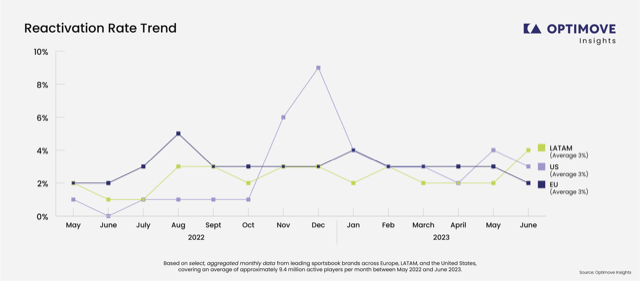
In Europe, reactivation remains relatively stable, suggesting a habit-driven market. In Latin America, reactivation rises modestly during the tournament, reflecting responsiveness to major football moments without sharp volatility.
In the United States, reactivation spikes sharply during the World Cup and drops just
as quickly afterward. The event successfully pulls inactive bettors back into sportsbooks, but without structural follow-through, that engagement dissipates.
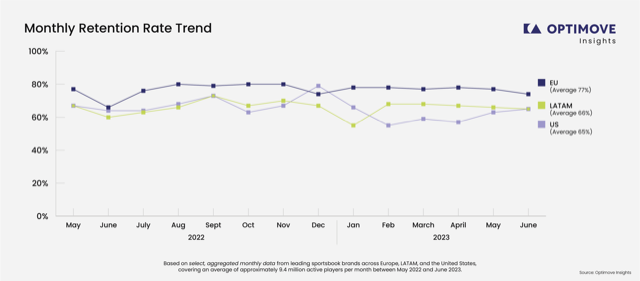
Retention data tells the same story. Europe maintains high and consistent retention. Latin America sees more post-event drop-off but retains a meaningful share of engagement. The U.S. exhibits a clear spike-and-decline pattern, driven by short-term excitement rather than habit.
Preparing for 2026: Strategic Implications for Sportsbooks
As the industry approaches 2026, sportsbook operators should consider three strategic imperatives.
First, treat the World Cup as an acquisition accelerator, not a retention solution. Success should be measured by post-event engagement and lifetime value, not peak tournament volume.
Second, plan regionally, not globally. Market maturity, cultural affinity, and local sports calendars shape outcomes. A single global strategy will not produce consistent results.
Third, use the expanded 2026 format to build habits, not just excitement. The longer schedule and summer timing create space to introduce bettors to recurring football moments that persist beyond the tournament.
In the United States, this means deliberately connecting World Cup engagement to MLS, European leagues, and international competitions that continue throughout the year. In mature markets, it means deeper personalization and value optimization rather than broadbased promotions.
An Inflection Point for the Industry
The 2026 World Cup will be the largest and most geographically accessible tournament the industry has ever seen. It will generate unprecedented acquisition and engagement.
What remains uncertain is how much of that engagement becomes durable.
For operators to optimize long-term player value, they must rethink their World Cup strategy for a tournament that could serve as an inflection point, one capable of engaging the entire world in football betting, including the traditionally reluctant United States.
This article first appeared in the January 2026 issue of GIQ magazine
Partner Editorial