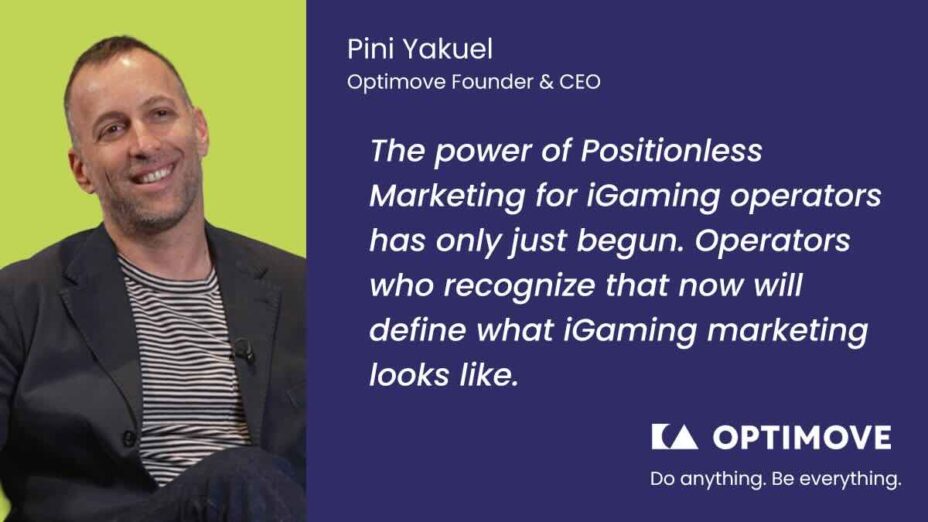
Optimove CEO Pini Yakuel explains how the early results of its Positionless Marketing platform are paying off for iGaming operators
FDJ United has reduced campaign execution time from six weeks to one day, Caesars Entertainment from five days to five minutes. But these numbers are only the opening signal of something much larger.
To understand why those numbers matter, it is important to understand what they replaced.
The Assembly Line Age of Marketing is Over
For decades, marketing teams have operated as an assembly line of hand-offs. The CRM team waits for the data team. The data team waits for approvals. The creative team waits for the brief. By the time execution begins, the customer moment is gone. In an industry where a match is always starting and a player is always logging in, that structural drag is not a minor inefficiency. It is an existential risk.
Positionless Marketing is the response.
The Positionless Marketer: Freed from the Assembly Line to Execute
Positionless Marketing frees teams from the limitations of fixed roles, giving every marketer the power to execute any marketing task instantly and independently. It does this through three transformative powers.
Data Power lets anyone immediately discover customer insights for precise targeting and hyper-personalization, without waiting for engineers. Creative Power lets anyone instantly produce channel-ready assets, copy, and visuals, without waiting for a separate creative function. And Optimization Power lets anyone run campaigns that test and optimize themselves, without waiting for analysts. Hand-offs are eliminated. The marketer is no longer waiting for anyone.
Three operators across three very different markets have already proven what that new-found Positionless freedom looks like in practice.
Three More Examples of Positionless Marketers’ Execution Power in iGaming
Across iGaming, operators who have embraced Positionless Marketing are delivering results that would have been difficult to achieve inside the old organizational model. These are not isolated wins. They are proof points, the opening signals of a much larger shift.
Stoiximan, the Greek market leader with over one million customers, had built impressive automation and then watched it become a bottleneck. Updates to lifecycle journeys took weeks. Data requests added days of lag. Customer moments passed before campaigns could respond. By restructuring around marketer autonomy and giving their CRM team real-time access to behavioral insights without depending on the data team, Stoiximan rebuilt more than 70% of its CRM lifecycle without slowing down. Output increased dramatically, not by adding headcount, but by removing friction. The cultural shift that followed, marketers thinking like analysts and analysts thinking like growth drivers, turned out to matter as much as the metrics.
Lottoland, managing 21 million customers across 15 markets, faced a different version of the same problem. A marketing technology stack so fragmented it took 64 steps to execute a single campaign. Consolidating into a unified platform saved nearly 300 hours per month and approximately €1 million per year. But the deeper win was what it unlocked inside the organization. When marketers work in one place, being Positionless, instead of navigating a dozen disconnected systems, they stop spending their energy on coordination and start spending it on customers.
BetJets, a mobile-first operator in South Africa, used marketer autonomy to solve a conversion problem the standard industry playbook had failed to crack. By replacing repetitive bonus reminder campaigns with a gamified earned-reward experience, built and launched entirely without custom development, they delivered a 3.5x uplift in first-time deposits. The marketing team moved at Positionless marketing speed, not engineering speed. The gap between idea and live campaign closed. And the result was not a one-off experiment but a new piece of standard conversion infrastructure.
Three different markets. Three different challenges. One consistent finding: when you remove the organizational barriers between the marketer and the customer, performance follows.
But execution speed, as transformative as it is, is Chapter 1 of what Positionless Marketing makes possible.
The Next Power Play: From Execution to Decision Management
What Positionless Marketing has delivered to date is primarily a story about execution. That alone is transformative. But the next evolution goes further. It moves the marketer from execution to decision management.
The emergence of AI agents is making this possible. Not by replacing the marketer, but by fundamentally changing what the marketer is responsible for. The right mental model is not human versus machine. It is human plus machine, with the human in charge.
In this model, the Positionless Marketer becomes a manager of agents, a multidisciplinary strategist who deploys AI to handle what previously required three different teams. Agents that surface customer insights without a data request. Agents that generate and test creative without a production cycle. Agents that optimize campaigns in real time without an analyst reviewing the output. The assembly line does not just get faster. It disappears entirely.
This is a promotion, not a replacement. But it comes with real demands. Marketers who can think strategically, not just operationally. Who can evaluate AI output critically, not just accept it. Who can take full accountability for every decision the agents make in their name. The technology is ready. The question is whether marketing organizations are ready to meet it.
What’s Next Will Dwarf What Positionless Marketing Has Already Accomplished
The pace of Positionless Marketing is not holding steady. It is accelerating. The gap between operators who have embraced this model and those who have not is already visible. It is about to become a chasm.
Marketers who are not already beginning to think of themselves as managers of agents will be left behind… not gradually, but suddenly. The operators still running assembly line marketing will find themselves competing against teams that move with speed and precision matching the pace of a player’s interaction with platform.
The power of Positionless Marketing for iGaming operators has only just begun. The operators who recognize that now, who build the organizational posture, develop the strategic mindset, and commit to the cultural shift this moment demands, are the ones who will define what iGaming marketing looks like in the years ahead.
The rest will wonder what happened.
Partner Editorial