
Soft2Bet general counsel David Yatom Hay provides an overview of the compliance challenges facing betting operators ahead of the biggest FIFA World Cup tournament ever
The biggest betting event in history is about to land across three countries with fundamentally different regulatory frameworks, and most operators are not yet ready for the compliance pressure it will create.
The expanded 2026 World Cup will feature 48 teams and 104 matches across Canada, Mexico and the United States. For operators, that scale will significantly affect the entire customer journey, from new registrations and payment checks to geolocation, bonus eligibility, AML reviews, customer support and regulatory reporting.
Regular customers and higher-frequency bettors will be more active, and the tournament will also bring in people who rarely bet, including some who would not usually see themselves as part of a sportsbook audience. The player journey must be clear and smooth for someone using a betting product for the first time, without weakening the checks needed to identify customer protection, AML, or reporting risks.
Regulators will not lower expectations simply because the World Cup creates an unusual period of activity. Standards still need to hold up under increased scrutiny when demand rises, customer behaviour changes and the margin for operational error narrows.
North America keeps compliance local
I still sometimes hear US sports betting discussed as if it were one market. From my perspective, that misses the operating reality. An operator does not launch into “the US” in the abstract. It launches in New Jersey, Pennsylvania, Michigan or another specific state, each with its own licensing conditions, tax treatment, marketing rules, responsible gambling requirements, geolocation requirements and reporting deadlines.
That logic can also be applied to Canada, where provincial regulation and different routes to market shape how operators enter and run each province. Before World Cup traffic arrives, operators need to know which market they are serving, which rules apply, which reporting obligations sit behind the product and which controls need to be live.
New Jersey’s proposed A4838 temporary surcharge should act as a useful warning sign. The bill would add a 10% surcharge on sums received from online sports wagering tied to World Cup events, net of patron winnings, as part of temporary charges connected to hosting costs. Regardless of whether A4838 advances, it illustrates how quickly hosting jurisdictions can introduce event-specific tax, reporting and operational measures that licensed operators need to absorb.
A product cannot credibly be called “ready for the US market” unless it can support state-by-state requirements without sending operators back into development work each time a local rule changes. Licensing conditions, tax reporting outputs, responsible gambling controls, bonus restrictions and reporting requirements all need to be configurable by jurisdiction. When a state changes the treatment of a market, a promotion or a reporting line, the operator needs to respond quickly and keep a clear record of what changed, when it changed and why.
Europe brings compliance into the live customer journey
In the UK, financial vulnerability checks apply when a customer’s deposits minus withdrawals exceed £150 in a rolling 30-day period. Licensees must assess the risk, take proportionate action if risk is identified, and record the reason for that action. Regulators from Austria, France, Germany, Great Britain, Italy, Portugal and Spain have also called for stronger action against illegal online gambling and unauthorised advertising.
Affordability signals, bonus rules, AML monitoring and customer interaction records need to move through the platform quickly enough for the operator to act during the session, not after the risk has already passed through the system.
Compliance teams may have strong policies, but they often work with data split across payments, CRM, sportsbook activity and customer support. During a major tournament, that separation becomes harder to manage. Operators need one view of the customer risk picture, or systems that can move the right information quickly enough for compliance, trading and support teams to act with confidence.
Customer protection cannot rely on slower journeys
Some customers will be regular sportsbook users, placing more football bets than usual. Others may arrive with little experience of betting products, drawn in by the tournament rather than by a normal betting routine. The journey has to recognise that difference without turning every registration, deposit or withdrawal into a slow manual process.
Repeated document requests, unclear restrictions and badly timed checks can push genuine customers away from licensed operators, especially those using a sportsbook for the first time. If controls are too light, the operator faces missed AML signals, bonus abuse, failures in responsible gambling, and regulatory scrutiny after the tournament.
KYC, AML screening, device checks, geolocation, payment monitoring, and responsible gambling tools should provide operators with enough information to move low-risk customers through smoothly and identify higher-risk cases sooner. The same data discipline also applies to betting integrity, where suspicious betting patterns should be linked to customer and transaction records. That makes customer protection a product, data and operational issue as well as a legal one.
Compliance-ready platforms will have a commercial advantage
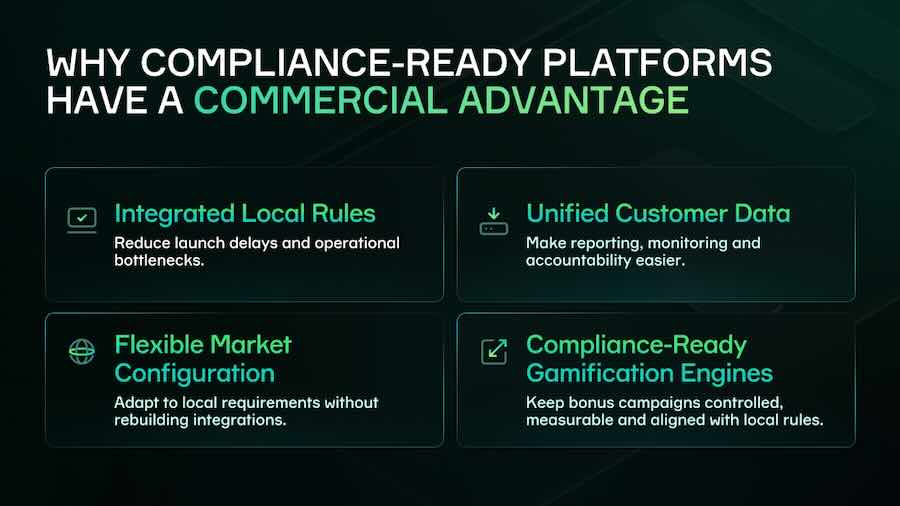
Local rules need to be reflected in how the product handles registration, payments, bonuses, customer communication, reporting and player protection. If those controls sit in a separate process that only the legal team understands, they become harder to apply during a period of heavy activity.
Before a tournament, operators may need to explain why a player was allowed to continue, why a bonus was offered, why a payment was reviewed or how revenue was classified and reported in a specific market. Those answers are harder to provide when the customer record is split across several vendors, dashboards and internal teams.
Platform structure determines how easily those rules can be applied in practice. Operators need to configure local rules without slowing the product or creating new operational gaps. Soft2Bet’s platform integrates these functions into a single system, allowing operators to adjust market rules, reporting outputs and compliance controls without rebuilding integrations each time a jurisdiction changes its requirements.
Promotional rules are becoming tighter, and the World Cup will create heavy marketing pressure. Operators need ways to segment customers, manage rewards and keep a clear record of how offers are delivered. Soft2Bet’s MEGA supports this through configurable gamification engines that allow operators to set rewards, bonus triggers, user segmentation and levels of difficulty.
Operators who prepare early will have more room to grow
Operators preparing now should stress-test the parts of the journey most likely to come under pressure during the tournament: registration flows, KYC and AML rules, responsible gambling triggers, geolocation accuracy, payment review queues, customer support escalation and reporting outputs. A control built into policy offers limited comfort if it cannot operate when demand rises, trading activity increases and customer contact volumes grow at the same time.
This preparation has to involve product, compliance, trading, payments and customer support. Legal and compliance teams need to know how controls behave during a surge, not just whether they exist on paper.
Campaign spend alone will not decide who benefits from the opportunity. Operators need to bring new players into licensed channels, keep checks proportionate, protect vulnerable customers and respond to regulators with clear records. A final round of checks close to kick-off will not be enough if the product, data and reporting processes have not already been pressure-tested.
In a World Cup year, speed needs an audit trail. Operators need to onboard, monitor and report quickly, but every decision should still be explainable. The strongest operators will be those that can manage the surge in activity without losing control of the customer journey or the compliance record behind it.
Partner Editorial