
Lottery couriers have been active in the United States for more than 10 years, but their reach is still relatively limited. Jackpot.com chief strategy and data officer Mike Silveira explains his company’s plan to grow the market
Sports betting in the United States has grown rapidly since the repeal of the Professional and Amateur Sports Protection Act (PASPA) in 2018, with 40 US jurisdictions now allowing online or retail betting.
In comparison, only eight states have a regulated online gaming market, and the landscape for lottery couriers is even more restrictive. There are just five states that currently authorise the activity and seven states that expressly prohibit it. Many other states are a legal grey area.
This has resulted in limited competition in the lottery courier space, and as Silveira notes, there are not many $100 billion market opportunities in which only a handful of companies compete.
What is Jackpot.com?
Silveira describes Jackpot.com as the Uber Eats or DoorDash of lottery tickets.
A player places an order for a state lottery ticket via the Jackpot.com app, picking their numbers just as they would on a regular ticket. One of the company’s couriers based in the same state as the player then purchases a physical ticket from an authorised lottery retailer on behalf of the player.
Jackpot.com takes a fee for this service, which depending on the market can be up to 20 per cent of the cost of the ticket, but it does not take a share of any winnings.
Silveira joined the company in 2022 as chief of staff, becoming Jackpot.com’s first US hire. He joined the company after six years in corporate development at live event marketplace StubHub.
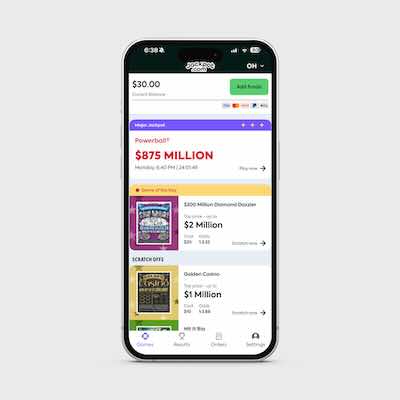
Jackpot.com was launched in 2016 as the third lottery courier to enter the US after Jackpocket.com, which is now owned by DraftKings, and Lotto.com.
Jackpot.com is the brainchild of three co-founders: Roi More, who in 2006 founded the online lottery affiliate site MyLotto.com; Yariv Ron, who with More co-founded iGaming platform ProgressPlay; and Christopher Brown, a businessman from Yorkshire, England.
Akshay Khanna, who worked with Silveira at StubHub as general manager of North America, joined as CEO and co-founder of Jackpot.com’s US business in 2022. Prior to this, Jackpot.com operated in Europe, with the majority of its European business being in the United Kingdom. The company closed its European operations earlier this year.
The regulatory picture
Jackpot.com’s US business is based in San Francisco and currently operates in seven states – New York, New Jersey, Arkansas, Colorado, Arizona, Massachusetts and Ohio – with the group’s main headquarters in Malta.
When it comes to regulation, as is often the case with US gambling products, the framework can be complex and varies state by state. The first five states mentioned above have regulations in place that cover lottery courier services, while Massachusetts and Ohio are grey markets.
There are seven US states where Jackpot.com’s model is prohibited, including California, Florida, Indiana, Mississippi, Texas, Virginia and Wisconsin. Some states do not regulate lottery couriers directly but instead regulate the retailers that work with them.
An investable idea
In the same year Silveira joined, Jackpot.com completed a $42 million Series A funding round backed by investors such as DraftKings CEO Jason Robins, the Dallas Cowboys, and the New York Yankees.
This was followed in January of this year with a $10 million revolving credit facility from Discerning Capital, which will support Jackpot.com’s expansion in the US.
At the time of the announcement, Discerning Capital partner David Williams said that the lottery sector “represents a massive, yet under-digitised market within gaming”.

“When jackpots reach record levels, we invest heavily in customer acquisition,” Silveira (pictured) tells Gaming Intelligence. “We know those customers are likely to generate revenue over time because our retention is so strong, but as a growing startup, every dollar matters. Spending millions of dollars upfront and then waiting several months to recover that investment can put pressure on cash flow.
“The Discerning Capital facility helps smooth that process,” Silveira explains. “Rather than funding all of that customer acquisition ourselves, we’re able to spread those costs over time in line with the revenue those customers generate.”
Silveira says the lottery courier market is an attractive investment opportunity because unlike other gambling products, there is no exposure to loss for the company.
Jackpot.com’s business model differs to operators such as Lottoland in Europe, which offers wagers on lottery outcomes and make a margin on the difference between ticket sales revenue and the cost of payouts and insurance.
The market opportunity
According to Statista, the lottery market in the US generated approximately $109 billion in sales last year, with around 50 per cent of US adults purchasing a lottery ticket at least once a year.
“We were the third company to enter this space, but despite the size of the market, there are very few competitors, because the operational infrastructure is incredibly difficult to build,” says Silveira.
“Most industries with a $100 billion addressable market attract dozens of companies. In this category, there are only a handful because scaling the fulfilment operation is such a significant challenge.”
Silveira is keen to stress that lottery couriers do not cannibalise lottery sales, they aim to grow them. He sees Jackpot.com working more like an affiliate to the lotteries, providing marketing services to grow their customer base.
“State lotteries face challenges that are very different from ours,” he says. “Most have limited marketing budgets because they’re publicly funded organisations, so they can’t invest in customer acquisition the way private businesses can.
“As more states recognise the courier model doesn’t reduce lottery revenues – and instead helps expand the market – I expect many more will embrace it. We’re not taking margin away from lotteries. We’re driving innovation, increasing marketing reach and attracting new players.
“Many state lotteries also spend less than 1 per cent of their revenue on marketing,” he adds. “By investing heavily in customer acquisition, we’re effectively helping to promote the lottery in ways that many state lotteries simply can’t. We expect more states to adopt the courier model over time.”
A slow burn
After more than a decade, the lottery courier market in the United States is still limited, mirroring the development of the regulated iGaming market. Both face the challenge of vested interests.
“We do plan to expand into additional states because we believe the courier model creates significant value for state lotteries,” Silveira reiterates. “We’re not reducing their margins – they earn exactly the same amount from a Jackpot.com transaction as they do from a ticket sold in a convenience store.”
The problem that lottery couriers face is that state lotteries are intrinsically linked with state government, meaning that wider considerations come into play. When a person visits a convenience store to purchase their lottery ticket, they may spend another $10 or $20 on groceries or other products. A lottery courier will purchase their tickets and leave the store. This, and the lottery’s role in sustaining retail businesses, are the arguments that often prevail in any discussion of online lottery sales.
When states are able to overcome this argument, a new threat emerges for lottery couriers in the form of state iLottery programs that enable state residents to purchase draw tickets and play instant games online.
But Silveira rejects this. “We don’t see it that way,” says Silveira. “New Hampshire already has iLottery alongside courier services, and Massachusetts is launching iLottery as well.”
Massachusetts will be the first state where Jackpot.com operates directly alongside a state-run iLottery program following the launch of Mass Lottery Online on Monday (July 27).
DraftKings-owned Jackpocket.com is the leading lottery courier service and is active in 17 US jurisdictions.
As a private company, Jackpot.com does not publish its financial results. DraftKings does not provide specific figures for its lottery business but includes it in its ‘Other’ products segment, which also includes prediction markets, fantasy sports, and interest earned on customer deposits.
DraftKings’ revenue in the first quarter of 2026 from its Other products came to $89.9 million. At the time of the acquisition in 2024, DraftKings forecast that Jackpocket would drive $260 million to $340 million of incremental revenue and $60 million to $100 million of incremental Adjusted EBITDA in fiscal year 2026.
DraftKings’ Other products revenue in Q1 compares to iGaming revenue of $461.3 million and sportsbook revenue of $1.09 billion.
What next for Jackpot.com
While the company works to enter new US jurisdictions, it is also expanding its product portfolio with games that are complementary to the core lottery service.
“Customers expect an instant experience,” Silveira says. “Lottery gives us an enormous customer acquisition funnel, because around half of all Americans play each year. That creates opportunities to expand into adjacent products over time while continuing to build around the lottery customer.”
The size of the opportunity available to Jackpot.com is undeniable but it will have to convince state lotteries that it is an essential partner rather than a potential threat.