Optimove founder and CEO Pini Yakuel explains how the best iGaming marketers now work
I’ve spent years watching marketers get boxed in by their own tools.
So when I talk to a CRM marketer at a well-run iGaming operator today, I notice something. Their week sounds nothing like it did eighteen months ago. And that shift is exactly what I built this company to make happen.
Back then, marketers did a lot of waiting. A dashboard meant a ticket to the data team. A real-time trigger meant an engineering request that landed whenever it landed. Creative testing meant an A/B test and a two-week wait to see which guess won. The marketer’s output was capped not by their own ability, but by the queue in front of every team they depended on. We’ve always believed that is backwards. The marketers who are closest to the customer should never be the ones waiting the longest to act.
The research backs up what the early days of AI adoption really was. A May 2025 Forrester Opportunity Snapshot we commissioned found only 14 per cent of marketers were using AI to build audience segments. The visible work was getting automated. The decisions underneath it weren’t.
That gap has now closed. Not because of one tool, but because the leading marketers I talk to have stopped treating AI as something that just generates content. They started working with it in three places at once. That’s the shift we want to cover.
Inside: Managing Agents and Working Alongside Them
The old job was to build a journey. Specify the path, hardcode the branches, and maintain it indefinitely. The number of journeys a brand could run was capped by how many a team could physically build. Marketers had to accept that. The alternatives were worse: trigger off a single action or send to the whole database at 6pm and live with the average. We never thought that was good enough.
Our Native AI replaces that with agents handling decisioning, content creation, insights and optimization. In our AI Decisioning Studio, a marketer defines a strategy, activates decisioning agents for journey, offer, content, and send time, then monitors and optimizes from a single hub. What comes out is effectively an individual journey for every player across every channel, adjusting continuously. No one is building any of them by hand. The results show up in the numbers. For some clients, our AI decisioning agents achieve an 87 per cent increase in net revenue, three times higher average bet value, and 13.8 per cent more deposits.
We recently added OptiGenie, an in-platform conversational agent now in closed beta. A marketer can ask it in plain language about segments, promotions, triggers, campaigns, journeys or platform health, or have it build those components outright. Because it lives inside our platform, it already holds the context of the environment the marketer is working in, along with access to our specialized insights, creative and decisioning agents. An external AI assistant must go and request that context first.
What it doesn’t do is act alone, and that was a deliberate call on our part. OptiGenie turns a suggestion into a built component and hands it back to the marketer for review. It respects existing permissions and governance. Every campaign still requires marketer approval before it reaches a player, keeping the marketer in control of brand voice and regulatory requirements. In an industry with this much regulatory exposure, that’s the responsible way to build it.
Outside: Running the Program from a Chat Window
A marketer working outside our platform can now open Claude, ChatGPT, or Microsoft Copilot, describe what they want, and let the platform handle the work. Governance, frequency rules, and approvals remain fully intact. This is the Optimove MCP, part of Optimove AI, the only marketing AI suite operating in all three places at once. We don’t know of any other CRM marketing platform doing this.
A CRM manager can prompt Claude to find high-value players likely to churn in the next two weeks, build an audience from multichannel preference data, draft the email and SMS campaigns, and have it all ready inside Optimove for review. Teams also use it for CRM audits, cross-brand audience building, daily reporting, channel checks, reactivation planning, and segmentation strategy.
The results speak for themselves. A dozen marketers across ten brands assembled a four-million-customer audience overnight. One operator runs a ten-brand CRM from a single chat window. Another logged over a thousand audience checks in two weeks.
On Top: The Workflow Nothing Off-the-Shelf Covers
Every operator has at least one workflow that no product was ever going to ship for them, because it exists only in their business. I’ve heard this complaint for years, and it never had a good answer. Until now.
Our Custom Apps address exactly that: applications built by our AI engineers on top of the platform, using our data, creative and optimization layers, for needs no standard product covers. One live example gives a large operator visibility into which real-time events actually resulted in a campaign, and which did not. This is a gap that had previously been invisible and could only be investigated by raising support tickets one at a time.
The capability changed. So did the economics. Work that would once have needed a roadmap slot and a release cycle to justify it is now worth building for a single client.
Why All Three, and Why It Needs One Foundation
Any of these three on its own is useful. Together, they change what a marketing team is capable of. That’s the part we’d push operators evaluating platforms to press hardest on.
We’ve built our approach so a marketer can start anywhere: in Claude for ideation, in the platform for execution, in an Optimove Custom App for analysis, or the other way around, moving between all three in the same week. That only works because of the execution layer sitting underneath. It holds the work together and preserves governance regardless of where a task began, on top of a data platform handling real-time, batch and predictive workloads at once.
That foundation is what makes our three-place claim structural rather than a feature list. Decisioning is only as good as the signal feeding it. An MCP is only useful if what it reaches is accurate and live. A Custom App is only worth building on something that won’t shift underneath it. Platforms that bolted AI onto a batch-era data layer can demonstrate the first place and struggle with the other two. I’d argue that gap only widens from here.
The Same Capability for Enterprise and Startup Operators
What strikes me most is who’s doing this. It’s not just the operators with the deepest benches.
At the enterprise end, the constraint was never resources; it was coordination. Multiple brands, multiple jurisdictions, and several marketing systems stitched together meant friction, and decisions that couldn’t travel between channels.
At the startup end, the constraint was always resources. Now, two or three people cover what once took twenty, running the same ways of working, on the same platform, with the same decisioning. One recently onboarded operator had a 50,000-player dataset live and QA’d within two days, and was building target groups the same week. Our Optimove Ignite+ program, with preferential terms, prelaunch templates, and direct access to our success services, helped get them there.
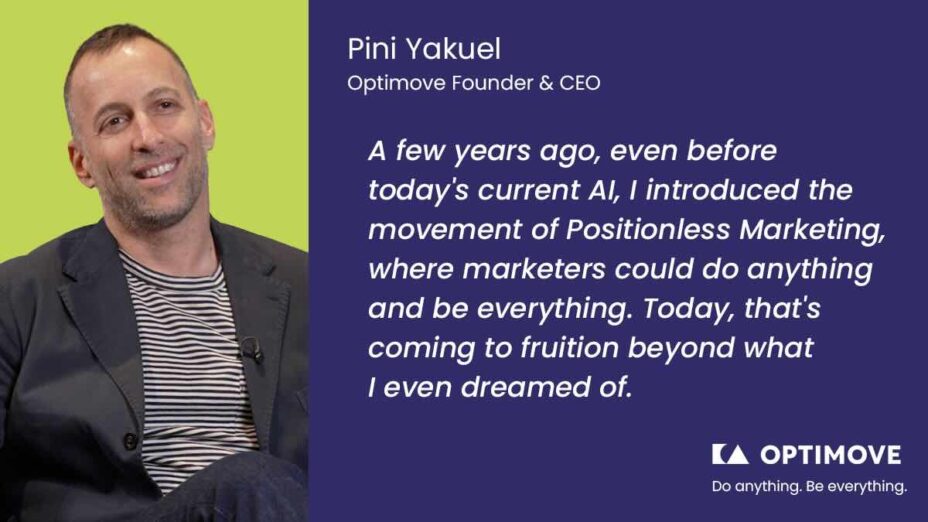
A few years ago, even before today’s current AI, I introduced the movement of Positionless Marketing, where marketers could do anything and be everything. Today, that’s coming to fruition beyond what I even dreamed of.
Partner Editorial